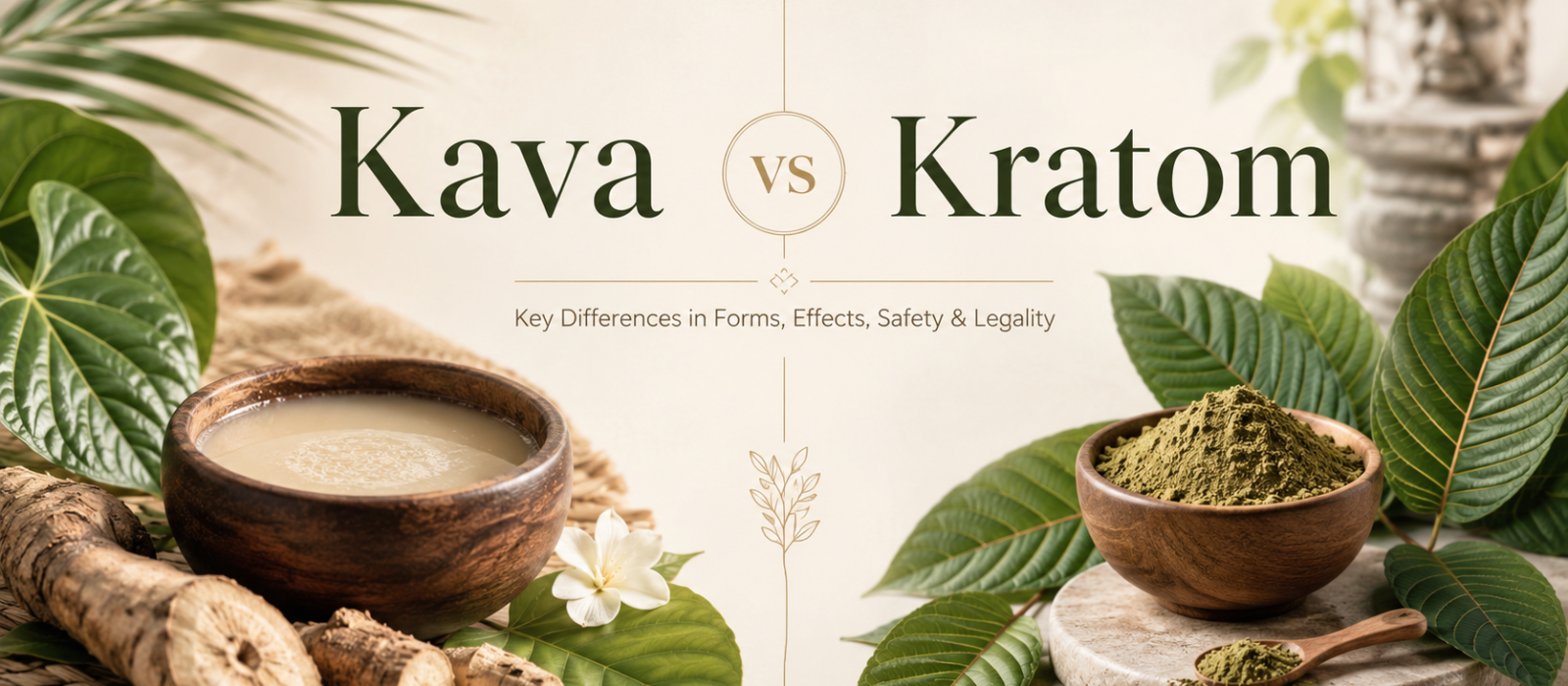

The Kava vs Kratom comparison often creates confusion because both botanicals are on the market in similar forms, including powders, capsules, extracts, and ready-to-drink beverages. Kava and Kratom products coem from plants with long histories of traditional use.
However, they come from different plants, contain different active compounds, and have distinct safety and dependence profiles. The root of Piper methysticum, is used to make Kava, while Kratom comes from the leaves of Mitragyna speciosa.
Understanding these differences is important because similar product formats such as powders, capsules, extracts, and drinks can make the two appear more alike than they really are. This guide compares Kava vs Kratom across their origins, compounds, reported effects, risks, legality, and modern product forms.
Quick Answer: Kava vs Kratom
- Kava and Kratom come from unrelated plants.
- Kava comes from the rootstock of Piper methysticum.
- Kratom comes from the leaves of Mitragyna speciosa.
- Kava’s primary compounds are kavalactones.
- Kratom contains alkaloids, primarily mitragynine and smaller amounts of 7-hydroxymitragynine.
- They do not work through identical biological pathways.
- Kratom generally carries a more established concern around physical dependence and withdrawal.
- Neither of them is risk-free
Key Takeaways
- Kava and Kratom are not the same plant.
- Kava uses the rootstock; Kratom products originate from leaves.
- Kavalactones and Kratom alkaloids interact with the body differently.
- Kratom’s interaction with opioid receptors contributes to greater dependence and withdrawal concerns.
- Product quality, extraction method, concentration and added ingredients can affect the risk profile.
- Legal status varies, especially for Kratom.
Kava Vs Kratom: At A Glance
| Comparison Point | Kava | Kratom |
| Scientific name | Piper methysticum | Mitragyna speciosa |
| Plant family | Pepper family, Piperaceae | Coffee family, Rubiaceae |
| Plant part traditionally used | Root and rhizome/rootstock | Leaves |
| Native region | South Pacific | Southeast Asia |
| Main compounds | Kavalactones | Mitragynine and related alkaloids |
| Primary mechanism discussed in research | Multiple nervous-system pathways | Activity involving opioid receptors and other systems |
| Traditional format | Water-prepared beverage | Chewed leaf or leaf-based preparation |
| Modern formats | Traditional drink, instant powder, capsules, extracts, canned beverages | Powder, capsules, tea products, extracts, shots and beverages |
| Opioid activity | Not classified as an opioid | Some alkaloids interact with opioid receptors |
| Dependence concern | Generally considered lower | More clearly associated with tolerance, dependence and withdrawal |
| Federal U.S. status | Not federally controlled | Not federally scheduled, but state and local restrictions apply |
| Main safety distinction | Liver concerns and sedative interactions | Dependence, withdrawal, product concentration and interaction concerns |
What Is Kava?
Kava is a tropical shrub native to the Pacific Islands whose roots are used to make a traditional, calming, non-alcoholic beverage and herbal supplements that promote relaxation and relieve anxiety.
It is botanically unrelated to Kratom, which is one of the first distinctions to understand in any Kava vs Kratom comparison. (NCCIH)
Where Does Kava Come From?
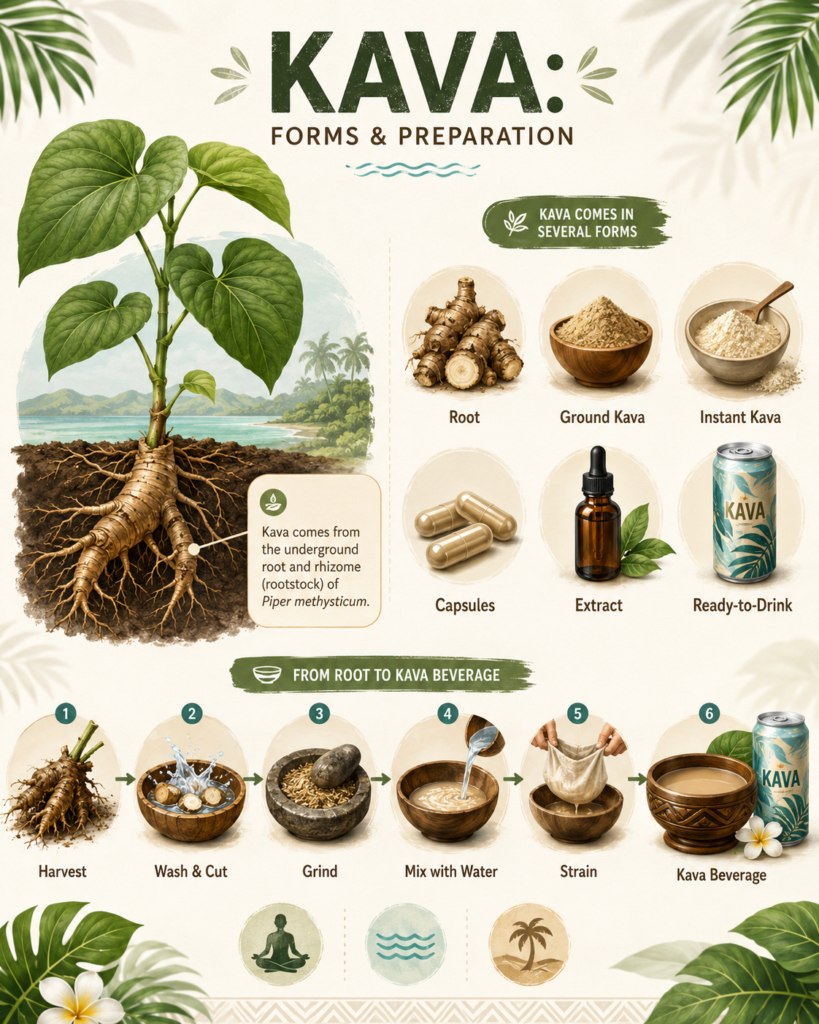
Kava is associated with Pacific Island nations and regions such as Vanuatu, Fiji, Tonga, Samoa, Hawaii, and parts of Micronesia. Traditionally, the plant’s roots and rhizomes are ground or crushed, mixed with water, and strained to produce a beverage.
This water-based preparation differs from many modern commercial products, which may use concentrated extracts or alternative processing methods. Traditional use and cultural context is not proof that every product sold as Kava has the same composition or safety profile. (PubMed Central (PMC))
What Are the Main Compounds in Kava?
Kava contains a group of naturally occurring compounds called kavalactones. Rather than relying on one primary compound, Kava contains several major kavalactones in varying proportions.
Here are the factors that influence chemical profile:
- Plant cultivar
- Plant part used
- Growing conditions
- Processing method
- Extraction method
- Final product concentration
These differences help explain why a traditional Kava beverage may not be directly comparable to a concentrated extract, capsule, or canned product.
What Forms Does Kava Come In?
Today, Kava is available in several formats, including:
- Traditionally prepared beverages
- Ground or instant root products
- Capsules
- Tinctures and extracts
- Ready-to-drink beverages
To learn more about traditional preparation methods, modern beverage formats, and how kava drinks have evolved, read our complete Kava drinks guide.
What Is Kratom?
Kratom is a tropical evergreen tree (Mitragyna speciosa) native to Southeast Asia whose leaves contain active compounds that produce both stimulant and opioid-like effects. It is sold in forms such as powders, capsules, and liquid extracts. It is native to Southeast Asia, particularly:
- Thailand
- Malaysia
- Indonesia
Unlike Kava, which comes from the underground parts of a pepper-family plant, Kratom comes from leaves and contains a different group of naturally occurring compounds.
Where Does Kratom Come From?
Kratom has a long history of traditional use in Southeast Asia. Historically, the leaves have been:
- Chewed fresh
- Dried for later use
- Prepared as tea
These traditional leaf-based preparations differ from many modern commercial products, particularly concentrated extracts and enhanced formulations.
This distinction matters because products labeled as Kratom can vary in:
- Composition
- Processing method
- Alkaloid concentration
- Added ingredients
- Finished product strength
What Are the Main Compounds in Kratom?
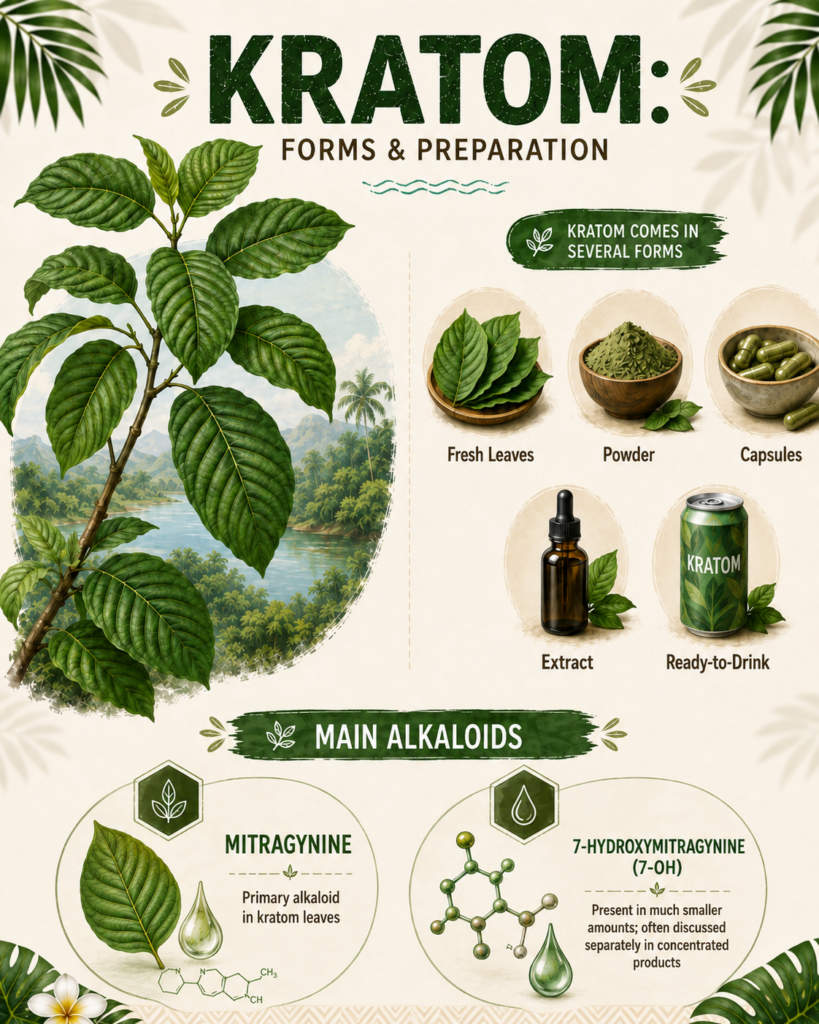
Kratom contains naturally occurring compounds known as alkaloids. The two most commonly discussed are:
- Mitragynine: The predominant alkaloid found in Kratom leaves
- 7-hydroxymitragynine: A related compound that receives scientific and regulatory attention
Unlike kavalactones, certain Kratom alkaloids interact with opioid receptors. This is one of the most important distinctions in the Kava vs Kratom comparison and helps explain why Kratom has a more clearly documented association with:
- Tolerance
- Physical dependence
- Withdrawal
The alkaloid profile of a finished Kratom product may vary according to:
- Plant material
- Growing conditions
- Harvesting practices
- Processing method
- Extract concentration
- Added or enhanced compounds
- Product storage and age
Commercial labels such as red, green, and white do not necessarily represent standardized or consistently verified alkaloid profiles.
What Forms Does Kratom Come In?
Modern Kratom products are available in several formats:
- Dried leaf powder
- Capsules
- Tea products
- Drink mixes
- Liquid extracts
- Shots
- Ready-to-drink Kratom beverages like seltzers
Why Are Kava and Kratom Often Confused?
Kava and Kratom appear in similar product categories and retail settings. However, these similarities relate mainly to how they are available on the market, not to their botanical origin or chemical composition.
Common reasons for the confusion include:
- Both come from plants with long histories of traditional use.
- The two are available on the market as powders, capsules, extracts, shots, and ready-to-drink beverages.
- Both may appear in botanical shops, specialty beverage stores, or Kava bars.
- Some commercial beverages contain both Kava and Kratom.
- It is an alternative to conventional alcoholic drinks.
- Product labels may use broad terms such as “botanical blend,” “plant-based tonic,” or “functional beverage.”
Kava vs Kratom Effects Compared
Kava and Kratom may both affect the nervous system, but their reported effects are not the same.
Moreover, Kratom associated with both stimulant-like and opioid-like effects, although most evidence about its perceived benefits comes from surveys, observational research, and self-reported experiences rather than clinical trials.
| Effect | Kava | Kratom |
| Anxiety-related effects | May reduce anxiety symptoms in some studies, although findings are mixed. (nccih.nih.gov) | Some users report taking it for anxiety-related reasons, but clinical benefit is not established. (pubmed.ncbi.nlm.nih.gov) |
| Energy and alertness | Not commonly associated with increased energy. | May produce stimulant-like effects, including increased energy and alertness. (nida.nih.gov) |
| Sedative-like effects | May cause mental or physical slowing, depending on the preparation. | May produce sedative- or opioid-like effects. (nida.nih.gov) |
| Mood-related changes | Mainly studied for changes in anxiety and tension rather than general mood improvement. | Users report changes in mood and sociability, but evidence is largely self-reported. (pubmed.ncbi.nlm.nih.gov) |
| Pain-related effects | Not established as an effective option for pain. | Reduced pain perception is commonly reported, but therapeutic effectiveness is not proven. (pubmed.ncbi.nlm.nih.gov) |
| Overall effect pattern | More commonly associated with anxiety-related and slowing effects. | More variable, with both stimulant-like and sedative-like responses reported. (nida.nih.gov) |
Kava Drinks vs Kratom Drinks
Kava drinks and Kratom drinks may appear in similar cans, bottles, or shots, but they contain different botanicals and active compounds. In addition to this, a drink’s format, extract type, concentration, and added ingredients can also make it very different from a traditional root- or leaf-based preparation.
| Comparison Point | Kava Drinks | Kratom Drinks |
| Botanical source | Made with kava root or root-derived extracts | Made with Kratom leaf material or Kratom-derived extracts |
| Main compounds | Kavalactones | Mitragynine and related alkaloids |
| Common formats | Traditional water-based drinks, instant beverages, extracts, and canned drinks | Teas, drink mixes, seltzers, liquid extracts, and shots |
| Traditional format | Root material mixed with water and strained | Leaves traditionally chewed or prepared as tea |
| Modern formulation | May contain standardized extracts, flavors, sweeteners, or other botanicals | May contain leaf extract, measured mitragynine, flavors, sweeteners, or other active ingredients |
| Main label detail | Kava type, plant part, extract, and kavalactone content | Kratom extract type, mitragynine content, and whether enhanced compounds are present |
| Key distinction | Traditional water-based kava and concentrated extracts may not have identical compositions | Natural Kratom leaf products should not be treated as equivalent to concentrated or enhanced alkaloid products |
Kava vs Kratom Legality: Are They Legal?
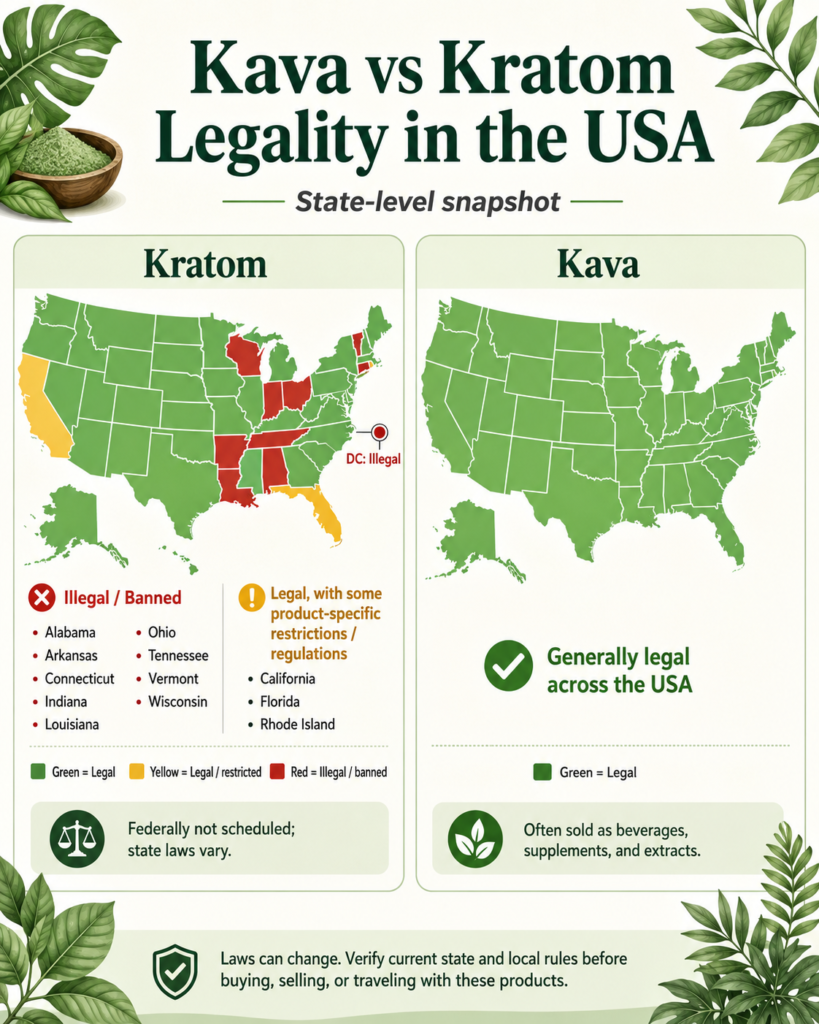
The legal status of kava and Kratom differs because they are regulated under different frameworks. Kava is generally treated as a botanical supplement or beverage ingredient, while Kratom has faced increasing regulatory scrutiny due to concerns around certain alkaloids, product claims, and concentrated formulations. Laws can also vary by state and local jurisdiction.
Is Kava Legal?
Kava is not federally scheduled as a controlled substance in the United States. It is commonly sold as a botanical product, including beverages, supplements, and extracts. However, federal legality does not mean every product is approved for medical use or free from regulatory requirements.
Key points about Kava legality:
- Kava is not listed as a controlled substance under federal law.
- Kava products are commonly sold as supplements or beverages.
- The FDA does not approve Kava as a treatment for anxiety or other medical conditions.
- Product labeling and safety requirements still apply.
- Some countries have additional restrictions on Kava products.
The National Center for Complementary and Integrative Health (NCCIH) notes that Kava products are sold in the United States as dietary supplements and that regulations differ between supplements and approved drugs.
Is Kratom Legal?
Kratom is not federally scheduled as a controlled substance in the United States, but its legality differs by state. Some states prohibit Kratom entirely, while others allow sales with regulations such as labeling requirements, age restrictions, or product standards.
States Where Kratom Is Banned
As of 2026, Kratom is banned statewide in:
- Alabama
- Arkansas
- Indiana
- Vermont
- Wisconsin
Rhode Island has implemented a regulated Kratom framework rather than a complete statewide prohibition, with restrictions on certain products and manufacturing standards.
States Where Kratom Is Legal
Kratom is legal at the state level in most of the United States, although regulations can vary. Many states allow Kratom sales while applying rules around:
- Minimum purchase age
- Product labeling
- Testing requirements
- Manufacturing standards
- Restrictions on specific compounds or enhanced products
States with Kratom consumer-protection regulations include jurisdictions that have adopted versions of the Kratom Consumer Protection Act (KCPA), which generally focuses on product quality, labeling, and sales standards rather than complete prohibition.
Because Kratom laws continue to change, checking current state and local regulations is important before purchasing, selling, or traveling with Kratom products.
Kava vs Kratom: Safety Risks and Addiction Potential
Neither Kava nor Kratom is risk-free. Kava’s main concerns involve liver risks, sedation, and interactions with other substances, while Kratom carries additional concerns involving tolerance, physical dependence, and withdrawal.
What Are the Safety Risks of Kava?
Kava products have been linked to rare cases of liver injury, including serious and fatal cases. Reports have involved both solvent-based extracts and beverages prepared with water.
Other safety concerns include:
- Drowsiness and dizziness
- Digestive discomfort
- Reduced coordination
- Interactions with alcohol, benzodiazepines, and other sedating substances
- Skin changes linked to prolonged, heavy exposure
Kava should not be combined with alcohol or other substances that have sedative effects. Anyone experiencing drowsiness, dizziness, or impaired coordination should avoid driving or operating machinery.
As per NCCIH, using dietary supplements like Kava responsibly is essential.
What Are the Safety Risks of Kratom?
The FDA has linked Kratom products to serious adverse events, including liver toxicity, seizures, and substance use disorder. Some deaths have also involved Kratom, although most reported cases included other substances, making Kratom’s individual role difficult to determine.
Other reported concerns include:
- Nausea and constipation
- Dizziness or drowsiness
- Product contamination
- Tolerance and withdrawal
- Greater risk when combined with other substances
Product quality is another concern. FDA testing has identified microbial contamination and elevated levels of certain heavy metals in some Kratom products.
Is Kava Addictive?
Kava has a lower documented physical-dependence potential than Kratom. A consistent kava withdrawal syndrome has not been clearly established, but repeated use may still become habitual or difficult to control.
A lower addiction risk does not mean Kava is safe for everyone. Liver concerns, impairment, and substance interactions can occur without dependence.
Is Kratom Addictive?
Regular Kratom use can lead to:
- Tolerance
- Craving
- Physical dependence
- Withdrawal after stopping
- Difficulty reducing use
Research involving regular users has linked Kratom with dependence, craving, and withdrawal, with more severe symptoms associated with longer or heavier patterns of use.
A systematic review also concluded that chronic Kratom use can result in tolerance, dependence, and withdrawal when use stops.
FAQs
What Is Healthier, Kava or Kratom?
Neither is universally healthier. Kratom has a more clearly documented risk of tolerance, dependence, and withdrawal. Kava has a lower dependence profile but carries separate concerns involving liver injury, impairment, and interactions with sedating substances.
Is Kava Similar to Xanax?
Kava is not the same as Xanax. Xanax contains alprazolam, while kava contains kavalactones. Although both may affect nervous-system activity, they differ in composition, mechanism, regulation, clinical evidence, and safety risks.
Does Kava Actually Get You Buzzed?
Kava can produce psychoactive changes that some people describe as a “buzz.” However, the term is subjective. Kava may alter alertness, physical sensation, or coordination, and its effects vary by preparation and individual response.
What Drug Is Kava Most Similar To?
Kava is not directly equivalent to a prescription drug. It is sometimes compared with benzodiazepines or alcohol because of overlapping sedative effects, but its kavalactones have a different pharmacological profile. Calling it “natural Xanax” is inaccurate.
Can You Take Kava and Kratom Together?
Combining kava and Kratom is not proven safe. Both can affect alertness and coordination, while Kratom may also produce opioid-like effects. Using them together could make the response and potential interactions less predictable.
Is Kratom an Opioid?
Kratom is a botanical, not a conventional prescription opioid. However, some of its alkaloids interact with opioid receptors and can produce opioid-like effects. This activity contributes to its dependence and withdrawal concerns.
Does Kava or Kratom Show Up on a Drug Test?
Kava and Kratom are not included in the standard five-class federal workplace testing panel. However, specialized laboratory tests can detect Kratom alkaloids or kavalactones in urine and other biological samples.
How Long Do the Effects of Kava vs Kratom Last?
There is no universal duration for either botanical. A 2024 study found that reported Kratom powder effects generally declined over about three hours. Kava duration varies by kavalactone profile, preparation, concentration, and individual metabolism.
Which Is More Addictive, Kava or Kratom?
Kratom has the greater documented addiction potential. Regular use may result in tolerance, craving, physical dependence, and withdrawal. Kava has a lower documented withdrawal risk, although repeated use can still become habitual or problematic.
Can You Drink Kava or Kratom Every Day?
Daily use is not safe. Repeated Kratom use may increase dependence and withdrawal risks, while long-term or heavy kava use raises liver, skin, interaction, and impairment concerns. Product concentration also matters.
Can You Mix Kava and Kratom?
Mixing kava and Kratom is not a risk-free combination. Their combined effects can be harmful, and products may contain extracts or additional active ingredients that increase unpredictability.
Kava vs Kratom: Final Thoughts
The Kava vs Kratom comparison comes down to two different botanicals with different compounds, effects, and safety considerations. Kava contains kavalactones from the root of Piper methysticum, while Kratom contains alkaloids such as mitragynine from the leaves of Mitragyna speciosa. Kratom has a more established association with tolerance, dependence, and withdrawal, while Kava carries separate concerns involving interactions, impairment, and rare liver injury reports. Neither of them is risk-free simply because it comes from plant.